
Blog
The Cessna 172 Skyhawk: The Airplane That Taught the World to Fly
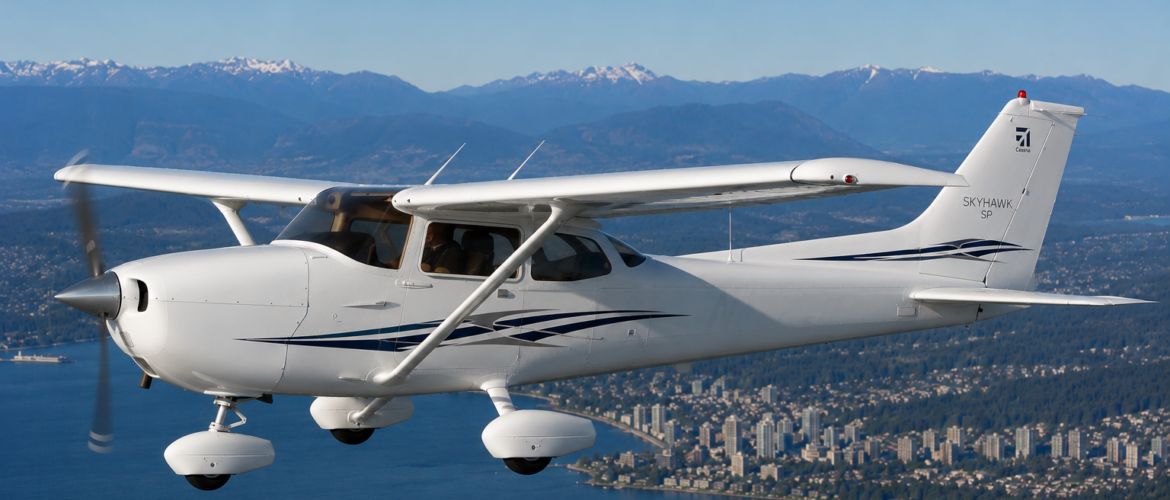
If there is one aircraft that defines general aviation, it is the Cessna 172 Skyhawk.
For generations of pilots, the Skyhawk has been the first aircraft they ever flew, the airplane in which they earned their pilot’s license, and the aircraft that introduced them to the freedom of flight. With more than 45,000 aircraft produced, the Cessna 172 is the most successful aircraft design in aviation history.
From flight schools and flying clubs to private owners and commercial operators, the Skyhawk continues to prove why simplicity, reliability, and practicality never go out of style.
The Birth of an Aviation Legend
The Skyhawk traces its roots to the 1950s when Cessna Aircraft Company sought to improve upon its successful tailwheel aircraft designs.
In 1956, the first Cessna 172 took flight. The new aircraft featured a tricycle landing gear configuration, making it easier to operate and more forgiving for student pilots than many tailwheel aircraft of the era.
What began as a modest four-seat utility airplane quickly became one of the most recognizable aircraft in the world.
Designed for Simplicity
One of the Skyhawk’s greatest strengths is its straightforward design.
The aircraft features:
- Four seats
- A high-wing configuration
- Fixed landing gear
- Simple systems
- Excellent visibility
- Predictable flight characteristics
Unlike more complex aircraft, the Skyhawk was designed to be accessible. Pilots could focus on learning how to fly rather than managing complicated systems.
This philosophy helped make aviation more approachable for thousands of aspiring aviators.
Why Flight Schools Love the 172
Walk onto almost any airport flight line and there is a good chance you will see a Skyhawk.
Flight schools around the world rely on the Cessna 172 because it offers an ideal balance of safety, performance, and affordability.
Students benefit from:
- Stable flight characteristics
- Forgiving stall behavior
- Easy landings
- Excellent instructor visibility
- Reliable systems
- Proven maintenance support
The aircraft is forgiving enough for beginners while still capable enough to support advanced training, including instrument flight instruction.
For many instructors, the Skyhawk remains the benchmark training aircraft.
A Global Success Story
The Cessna 172 can be found on nearly every continent.
It serves in:
- Flight training
- Personal transportation
- Aerial photography
- Patrol operations
- Mapping and surveying
- Government service
- Search and rescue support
Its adaptability has helped operators in countries ranging from Canada and the United States to Australia, Africa, Europe, and South America.
Few aircraft have achieved such global reach.
Performance That Gets the Job Done
The Skyhawk was never designed to be the fastest aircraft in the sky.
Instead, it was designed to be dependable.
Typical modern Skyhawk performance includes:
- Cruise speed: approximately 120–125 knots
- Range: approximately 600 nautical miles
- Service ceiling: approximately 14,000 feet
- Seating: four occupants
- Engine: 180-horsepower piston engine
While these numbers may not seem impressive compared to high-performance aircraft, they are more than adequate for training, recreational flying, and cross-country travel.
The Skyhawk’s efficiency and practicality are precisely why it remains so popular.
The Aircraft That Builds Confidence
Many pilots describe the Skyhawk as an aircraft that inspires confidence.
The high-wing design offers excellent downward visibility and provides shade during hot summer flights.
Its stable handling characteristics help reduce pilot workload, especially during training and cross-country flights.
For new aviators, the Skyhawk provides an ideal environment for learning fundamental flying skills:
- Takeoffs
- Landings
- Navigation
- Emergency procedures
- Radio communication
- Instrument flying
These skills form the foundation of nearly every aviation career.
Technological Evolution
While the basic design has remained remarkably consistent, the Skyhawk has evolved significantly over the decades.
Modern aircraft feature:
- Glass cockpit avionics
- GPS navigation systems
- Digital engine monitoring
- Traffic awareness technology
- Enhanced weather information
- Advanced autopilot systems
Today’s Skyhawk combines the reliability of a proven airframe with modern technology that would have seemed futuristic when the aircraft first entered production.
A Favorite in Canada
Across Canada, the Skyhawk has become a staple of flight training.
Many Canadian pilots complete their first solo flight, cross-country flight, and private pilot flight test in a Skyhawk.
From busy airports around the Greater Toronto Area to small rural aerodromes in Northern Ontario, the aircraft continues to help train the next generation of aviators.
Its ability to operate efficiently from a wide variety of airports makes it particularly valuable in Canada’s diverse flying environment.
The Most Important Airplane in Aviation
Many aircraft are faster.
Many aircraft are more powerful.
Many aircraft are more technologically advanced.
Yet few aircraft have had a greater impact on aviation than the Cessna 172 Skyhawk.
For nearly seventy years, it has introduced people to flight, helped launch professional aviation careers, connected communities, and made personal aviation accessible to countless pilots around the world.
The Skyhawk may not be the most glamorous aircraft ever built, but it is arguably one of the most important.
Its enduring success proves that a well-designed airplane never goes out of style.
Final Approach
The Cessna 172 Skyhawk is more than just an aircraft—it is a gateway into aviation.
For millions of pilots, it represents first flights, first solos, first licenses, and the beginning of a lifelong passion for flying.
As aviation continues to evolve, the Skyhawk remains exactly what it has always been: a trusted companion in the sky and one of the greatest training aircraft ever built.
Skyhawk Fun Fact: In 1958, a specially modified Cessna 172 set the world record for the longest flight ever performed by an aircraft. The crew remained airborne for 64 days, 22 hours, and 19 minutes, refueling from a moving truck while flying over the Nevada desert. The record still stands today. ✈️