
Blog
Starship: The Rocket That Could Turn Space Travel Into Air Travel
For more than a century, humanity has dreamed about travelling anywhere on Earth in a matter of minutes rather than hours.
Today, that dream may be closer than ever.
At the center of this vision is Starship, the massive fully reusable spacecraft being developed by SpaceX and championed by its founder, Elon Musk.
Most people know Starship as the rocket intended to carry humans to the Moon and Mars. However, Musk has repeatedly outlined another ambitious goal: using Starship to transport passengers between cities on Earth faster than traditional airliners.
If successful, the concept could fundamentally change global transportation.
The Vision: Earth-to-Earth Rocket Travel
Imagine boarding a spacecraft near Toronto.
After a brief launch sequence, the vehicle accelerates into space, travelling above the atmosphere where there is virtually no air resistance.
Instead of spending 12 to 15 hours flying across the Pacific Ocean, passengers could arrive in Asia in less than one hour.
That is the vision behind Starship’s Earth-to-Earth transportation concept.
According to SpaceX’s proposed travel profiles:
- New York to Shanghai: approximately 39 minutes
- London to New York: approximately 29 minutes
- Los Angeles to Toronto: less than 25 minutes
- Sydney to London: under one hour
In theory, almost any two cities on Earth could be connected in less than one hour.
How Would It Work?
Unlike traditional aircraft that fly through the atmosphere, Starship would operate more like a suborbital space vehicle.
Passengers would board at a coastal launch facility.
The rocket would launch vertically, accelerate into space, travel along a controlled suborbital trajectory, and then descend toward its destination.
Upon arrival, Starship would perform a controlled landing similar to the way SpaceX currently lands its Falcon rockets.
The trip would be dramatically faster than even the fastest airliners.
For comparison:
- Boeing 787 Toronto to Tokyo: approximately 13 hours
- Concorde London to New York: approximately 3 hours
- Starship concept Toronto to Tokyo: potentially under 1 hour
What Could This Mean for Canada?
Canada is one of the largest countries in the world.
Distance has always been one of our greatest challenges.
Travelling between Vancouver and Toronto takes approximately five hours by air. Reaching Europe or Asia often requires flights lasting 8 to 15 hours.
If Earth-to-Earth Starship transportation became practical, Canada’s geography would effectively shrink.
Potential future travel times could look like:
- Toronto to Vancouver: less than 30 minutes
- Toronto to London: less than 30 minutes
- Vancouver to Tokyo: under one hour
- Toronto to Dubai: approximately 40 minutes
For business, tourism, trade, and family travel, the implications would be enormous.
More Than a Rocket
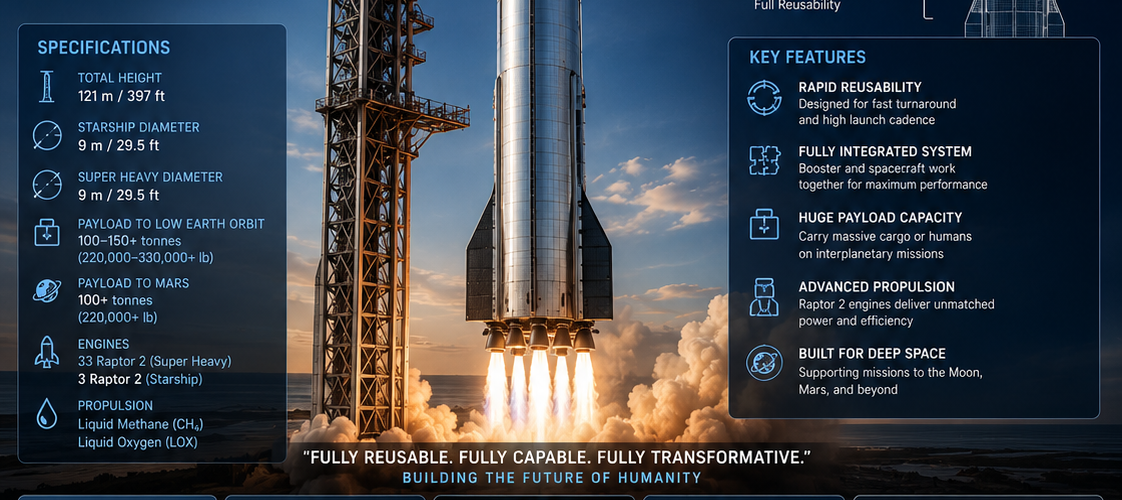
Starship is already the largest and most powerful rocket ever built.
Standing approximately 121 metres tall when combined with its Super Heavy booster, it dwarfs every operational launch vehicle in history.
The vehicle is designed to be:
- Fully reusable
- Rapidly refuelled
- High-capacity
- Capable of carrying over 100 people
- Suitable for missions to Earth orbit, the Moon, and Mars
The same technology needed to reach Mars is what makes global rocket transportation theoretically possible.
The Challenges Ahead
While the concept is exciting, significant challenges remain.
These include:
- Passenger safety certification
- Launch infrastructure
- Regulatory approvals
- Environmental considerations
- Noise management
- Economic viability
- Public acceptance
Modern airliners are among the safest transportation systems ever created. Any future rocket transportation network would need to achieve similarly high safety standards before widespread passenger adoption could occur.
The Future of Travel?
Many aviation breakthroughs once seemed impossible.
Crossing the Atlantic in a single flight.
Flying faster than sound.
Landing reusable rockets.
All eventually became reality.
Whether Starship ultimately becomes the world’s first global rocket transportation network remains to be seen.
However, the vision itself is remarkable.
For the first time in history, humanity is seriously exploring a future where travelling between continents could take less time than driving across a major city.
A Canadian Perspective
Canada has always embraced transportation innovation.
From the Avro Arrow and the Beaver to the Dash 8 and the Canadarm, Canadians have played important roles in advancing aerospace technology.
If Earth-to-Earth rocket travel becomes reality, Canada could be one of the countries that benefits most.
A nation defined by distance could suddenly become a nation connected in minutes.
The dream that once belonged to science fiction may eventually become as ordinary as boarding a flight at Toronto Pearson.