
Blog
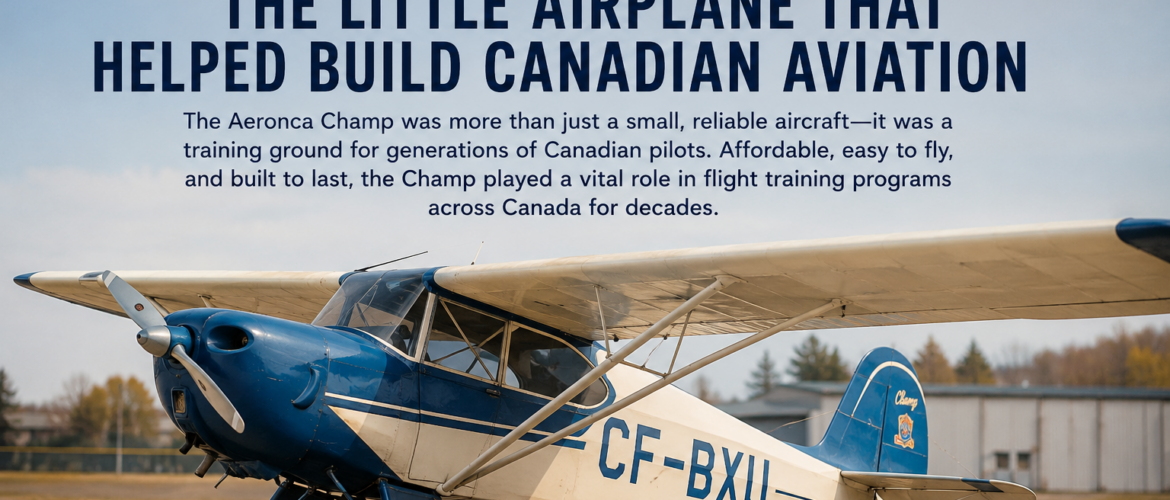
Long before glass cockpits, GPS navigation, and sophisticated flight simulators, there was a simple airplane teaching Canadians the fundamentals of flight.
That airplane was the Aeronca Champ.
While it may not be as famous as the Beaver, the Cessna 172, or the Twin Otter, the Aeronca Champ played an important role in Canada’s aviation history. For thousands of pilots after the Second World War, it was their first introduction to the skies.
Light, affordable, and easy to fly, the Champ became one of the aircraft that helped grow grassroots aviation across Canada.
Born After the War
The Aeronca 7AC Champion, better known simply as the “Champ,” first flew in 1945.
Following the end of World War II, aviation experienced tremendous growth throughout North America. Thousands of returning military pilots wanted to continue flying, while civilians suddenly found aviation more accessible than ever before.
The Champ was designed to meet this demand.
It was simple, economical, and fun to fly.
Most importantly, it was affordable enough for flying clubs, flight schools, and private owners.
Canada’s Flying Clubs Embrace the Champ
In the late 1940s and 1950s, flying clubs became a major part of Canadian aviation.
Across Ontario, Quebec, the Prairies, British Columbia, and the Maritimes, local flying clubs introduced Canadians to aviation using aircraft like the Aeronca Champ.
The aircraft’s low operating costs made it ideal for student training.
Many future airline pilots, bush pilots, military aviators, and instructors took their first lessons in a Champ.
For a generation of Canadian aviators, the sound of a small Continental engine and the feel of a tailwheel aircraft became their first aviation memories.
A True Taildragger
Unlike most modern trainers, the Aeronca Champ featured a conventional landing gear arrangement, commonly known as a tailwheel configuration.
This meant pilots learned:
- Rudder control
- Crosswind techniques
- Ground handling
- Precision landings
- Aircraft coordination
Many instructors believed tailwheel aircraft produced better stick-and-rudder pilots.
To this day, pilots who learned in Champs often speak fondly of the experience.
The airplane demanded attention and rewarded good flying habits.
Perfect for Canada’s Grass Airstrips
During the middle of the twentieth century, many Canadian airports looked very different than they do today.
Numerous communities operated from:
- Grass runways
- Farm fields
- Small municipal airports
- Flying club airstrips
The Champ excelled in these environments.
Its lightweight design and low stall speed made it ideal for short-field operations and recreational flying.
From southern Ontario to the Prairies, Champs became a common sight at local airports.
Building Canada’s Aviation Culture
Perhaps the Champ’s greatest contribution to Canada was cultural rather than technological.
The aircraft helped make flying accessible.
It inspired people who otherwise may never have entered aviation.
Many future:
- Airline captains
- Bush pilots
- Flight instructors
- Aircraft mechanics
- Aviation entrepreneurs
began their journey in simple aircraft like the Champ.
The airplane helped build Canada’s aviation community from the ground up.
A Favorite Among Vintage Aircraft Enthusiasts
Today, many Aeronca Champs continue flying across Canada.
Restored examples can be found at:
- Vintage aircraft gatherings
- Fly-ins
- Airshows
- Private airfields
- Aviation museums
Pilots continue to appreciate the aircraft’s simplicity and pure flying characteristics.
In an era of automation and advanced avionics, the Champ offers something increasingly rare:
A direct connection between pilot and airplane.
Why Pilots Still Love the Champ
The Aeronca Champ remains beloved because it reminds pilots why they started flying in the first place.
There are no complex systems.
No flight management computers.
No autopilot.
Just a pilot, an airplane, and the sky.
For many aviators, that is aviation in its purest form.
A Lasting Legacy in Canada
The Aeronca Champ may never have broken speed records or crossed oceans.
Yet its contribution to Canadian aviation is undeniable.
By introducing thousands of Canadians to flight, the Champ helped create generations of aviators who would go on to serve airlines, northern operators, military units, and flying clubs across the country.
Sometimes the most important aircraft are not the fastest or the largest.
Sometimes they are the aircraft that inspire people to dream.
For countless Canadian pilots, that dream began in an Aeronca Champ.
A friend has lost his licence, and I am helping the family sell his Aeronca Champ, 1949 model, on owner maintenance. The plane was maintained by his son, who worked for Ken Borac Air. I need some idea of what to advertise it for.