
Blog
Douglas DC-3: The Airplane That Connected Canada
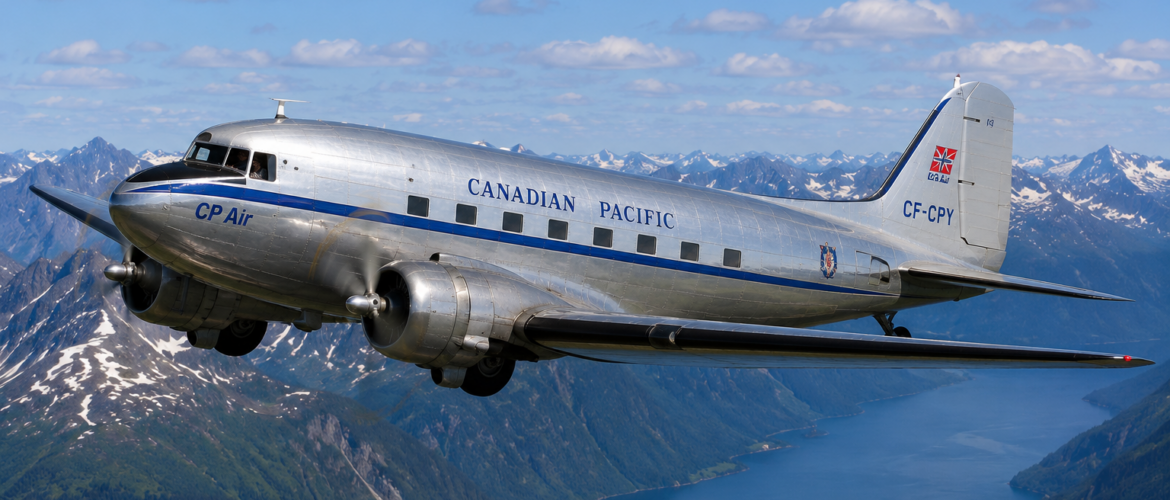
If the Beaver built Canada’s North and the Twin Otter connected its remote communities, the Douglas DC-3 helped bring commercial aviation to the masses.
Widely regarded as one of the greatest aircraft ever built, the DC-3 transformed air travel around the world and played a critical role in Canada’s aviation development. Reliable, rugged, and capable of operating from primitive airfields, the aircraft became the backbone of airlines, cargo operators, and bush flying companies across the country.
More than 90 years after its first flight, many DC-3s continue flying today—a remarkable achievement for any aircraft.
The Airplane That Changed Aviation
When the Douglas DC-3 first flew in 1935, commercial aviation changed forever.
Before the DC-3, passenger air travel was expensive, uncomfortable, and still considered unusual by many people. Aircraft were often smaller, slower, and less reliable than what airlines needed for consistent scheduled service.
The DC-3 changed that.
It could carry passengers farther, faster, and more comfortably than earlier aircraft. It was also economical enough for airlines to operate profitably, helping make commercial aviation a real business rather than a luxury experiment.
Canada’s Early Airline Workhorse
In Canada, the DC-3 became an important part of early airline growth.
Trans-Canada Air Lines, which later became Air Canada, operated DC-3s as part of its expanding national network. The aircraft helped connect major cities, regional communities, and remote destinations at a time when long-distance travel across Canada was still difficult.
For many Canadians, the DC-3 represented their first experience with airline travel.
It helped make flying feel practical, reliable, and modern.
Built for Tough Conditions
Canada’s climate and geography demanded aircraft that could handle more than smooth paved runways.
The DC-3 proved it could operate in challenging conditions across the country, including:
- Cold winters
- Gravel runways
- Remote airfields
- Northern routes
- Cargo operations
- Military support missions
Its rugged construction and dependable radial engines made it a natural fit for Canadian operators.
From Airliner to Bush Plane
After newer airliners entered service, many DC-3s found a second life in northern and remote operations.
Across Canada, the aircraft was used to carry:
- Passengers
- Food and supplies
- Mining equipment
- Fuel drums
- Medical cargo
- Community freight
The DC-3’s large cabin and strong payload capability made it ideal for supporting communities and industries far from major cities.
A Wartime Legend
The military version of the DC-3, known as the C-47 Skytrain or Dakota, became one of the most important transport aircraft of the Second World War.
Canadian crews flew C-47s in transport, supply, and support missions. After the war, many surplus aircraft entered civilian service and continued working for decades.
This gave the DC-3 a unique legacy: it helped win a war, then helped build peace by connecting people, businesses, and communities.
Still Flying in Canada
One of the most amazing things about the DC-3 is that some examples still fly today.
In Canada, preserved and working DC-3s continue to appear at museums, airshows, heritage events, and specialized operations.
Their continued presence is proof of the aircraft’s incredible design.
Very few airplanes remain useful for nearly a century.
The DC-3 is one of them.
Why Pilots Respect the DC-3
Pilots respect the DC-3 because it is honest, durable, and dependable.
It requires skill to fly well, but rewards good technique. Its tailwheel design, radial engines, and classic cockpit layout remind pilots of an era when aviation demanded physical skill, judgment, and mechanical understanding.
For many aviators, flying a DC-3 is not just operating an aircraft.
It is touching history.
A Lasting Canadian Legacy
The Douglas DC-3 helped shape Canadian aviation by making air travel more accessible, supporting northern development, and proving that aircraft could reliably connect a country as vast as Canada.
It served airlines, the military, cargo companies, remote communities, and countless passengers.
Few aircraft have done so much, for so long.
The DC-3 was not just an airplane.
It was the aircraft that helped Canada move into the modern age of aviation.
Douglas DC-3 Fast Facts
Manufacturer: Douglas Aircraft Company
First Flight: 1935
Crew: 2
Passengers: Approximately 21–32
Engines: Twin radial engines
Cruise Speed: Approximately 180 knots
Canadian Role: Airline service, military transport, cargo operations, northern flying, heritage aviation
Fun Fact
The DC-3 was so well designed that many aircraft built in the 1930s and 1940s are still flying today, making it one of the longest-serving aircraft in aviation history.
Legend Status
⭐⭐⭐⭐⭐
The Douglas DC-3 helped connect Canada by air and remains one of the most important aircraft ever built.