
Blog
Boeing 777: The Aircraft That Made the World Smaller for Canadians
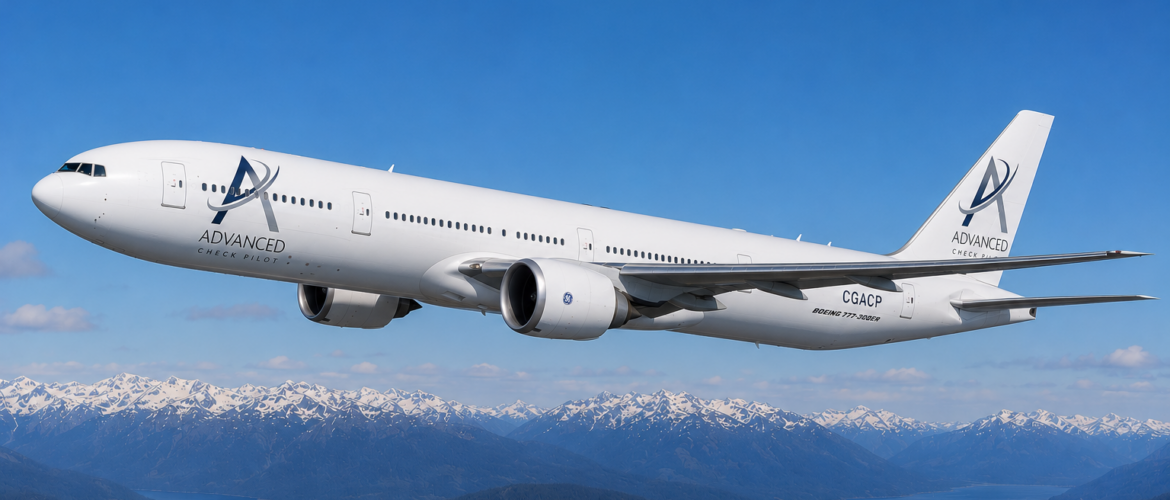
When Canadians think about long-haul international travel, few aircraft have played a larger role than the Boeing 777.
Known for its massive engines, exceptional range, and outstanding reliability, the Boeing 777 has become one of the most successful wide-body airliners ever built. For Canada, it helped transform international travel by connecting major Canadian cities directly to destinations around the globe.
Whether flying across the Atlantic, Pacific, or deep into the Southern Hemisphere, the Boeing 777 has carried millions of Canadians farther than ever before.
A Revolutionary Airliner
When the Boeing 777 entered service in 1995, it represented a new generation of aviation technology.
The aircraft was designed to provide:
- Long-range capability
- Exceptional fuel efficiency
- Large passenger capacity
- Advanced flight systems
- Twin-engine reliability
At the time, many airlines still relied on three- and four-engine aircraft for long-haul routes.
The 777 helped prove that a twin-engine aircraft could safely and efficiently connect cities separated by oceans and continents.
Air Canada’s Long-Haul Flagship
Few airlines are more closely associated with the Boeing 777 in Canada than Air Canada.
The airline introduced the 777 into its fleet in 2007, marking a major step forward in international operations.
The aircraft quickly became the flagship of Air Canada’s long-haul network, serving destinations including:
- London
- Paris
- Frankfurt
- Tokyo
- Seoul
- Hong Kong
- Shanghai
- Delhi
- Sydney (historically)
- Various Middle Eastern destinations
For many Canadians, the Boeing 777 became their gateway to the world.
Built for Canada’s Geography
Canada’s location presents unique opportunities and challenges.
As a country positioned between Europe, Asia, and the Americas, airlines require aircraft capable of flying enormous distances efficiently.
The Boeing 777 excels in this role.
Its long range allows airlines to operate nonstop flights connecting Canada directly to major international destinations.
This means passengers can travel farther with fewer connections, saving both time and convenience.
The Engine Giants
One of the most impressive features of the Boeing 777 is its engines.
The aircraft is powered by some of the largest and most powerful jet engines ever installed on a commercial airliner.
Depending on the model, these include:
- General Electric GE90
- GE9X
- Pratt & Whitney PW4000
- Rolls-Royce Trent 800
The GE90, used on many 777 variants, holds the record as one of the most powerful commercial jet engines ever built.
Standing beside a 777 engine is often one of the most memorable experiences for aviation enthusiasts.
A Favorite Among Passengers
Passengers appreciate the Boeing 777 for its comfort and spacious cabin.
The aircraft typically offers:
- Wide-body seating
- Large overhead bins
- Advanced entertainment systems
- Long-haul comfort
- Quiet cabin environments
For flights lasting ten, twelve, or even fifteen hours, passenger comfort becomes increasingly important.
The 777 was designed with these long journeys in mind.
A Cargo Champion
The Boeing 777 is not only a passenger aircraft.
It has also become one of the world’s most successful cargo platforms.
Canadian operators and international carriers use the aircraft to transport:
- Medical supplies
- Industrial equipment
- E-commerce shipments
- Perishable goods
- International freight
Its impressive payload capacity makes it a vital part of global trade and logistics networks.
ETOPS and Long-Ocean Flights
The Boeing 777 helped redefine what was possible for twin-engine aircraft.
Through advanced ETOPS certification, the aircraft routinely operates routes across:
- The Atlantic Ocean
- The Pacific Ocean
- Polar regions
- Remote northern routes
Many flights connecting Canada with Asia travel over Arctic regions and some of the most remote areas on Earth.
The 777’s reliability made these operations practical and economical.
Why Pilots Love the 777
Among airline pilots, the Boeing 777 enjoys an almost legendary reputation.
Pilots often praise:
- Excellent handling characteristics
- Advanced automation
- Reliable systems
- Comfortable cockpit design
- Exceptional performance
Many professional aviators consider it one of the finest airliners ever built.
Its blend of technology and pilot involvement has made it a favorite throughout the aviation community.
The Aircraft That Connected Canada Globally
The Boeing 777 arrived at a time when international travel was expanding rapidly.
For Canada, the aircraft helped strengthen connections with:
- Europe
- Asia
- South America
- Africa
- Oceania
Businesses gained greater access to global markets, tourism increased, and Canadians could travel farther than ever before.
The aircraft helped make the world feel smaller.
A Lasting Legacy
Today, the Boeing 777 remains one of the most important aircraft in Canadian aviation.
Although newer aircraft such as the Boeing 787 Dreamliner have entered service, the 777 continues to serve as a backbone of many international operations.
Its combination of range, reliability, capacity, and comfort has secured its place among the greatest airliners ever built.
For millions of Canadians travelling abroad, the Boeing 777 has been the aircraft that carried them across oceans and around the world.
Boeing 777 Fast Facts
Manufacturer: Boeing Commercial Airplanes
Country of Origin: United States
First Flight: 1994
Entry Into Service: 1995
Passengers: Approximately 314–426 depending on configuration
Cruise Speed: Approximately 490 knots
Range: Up to 8,700 nautical miles depending on variant
Canadian Role: Long-haul international travel, cargo operations, tourism, global business connectivity
Fun Fact
The Boeing 777’s GE90 engines are so large that the diameter of a single engine is wider than the fuselage of a Boeing 737.
Legend Status
⭐⭐⭐⭐⭐
The Boeing 777 helped connect Canada to the world, becoming one of the most capable and respected long-haul airliners in aviation history.