
Blog
B-17 Flying Fortress: The Bomber That Helped Win the War
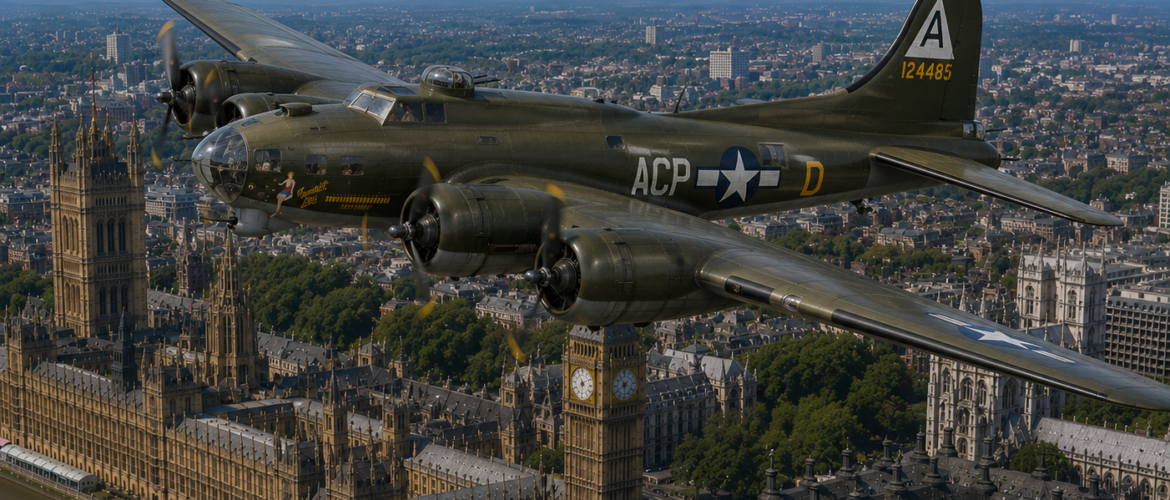
Few aircraft from the Second World War are as legendary as the Boeing B-17 Flying Fortress.
With its distinctive silhouette, four powerful radial engines, and reputation for bringing crews home despite incredible battle damage, the B-17 became one of the most famous military aircraft ever built. It symbolized the courage of Allied aircrews and played a major role in the strategic bombing campaign that helped bring the war in Europe to an end.
For Canadians, the Flying Fortress also holds a special place in history. Thousands of Canadians served alongside Allied bomber crews, and many encountered the mighty B-17 throughout the war.
More than 80 years later, the aircraft remains one of the most respected warbirds ever to take flight.
Born Before the War
The B-17 first flew in 1935, years before the United States entered the Second World War.
Designed by Boeing as a long-range heavy bomber, the aircraft was intended to carry large bomb loads over great distances while defending itself against enemy fighters.
Its impressive design included:
- Four radial engines
- Long-range capability
- Heavy defensive armament
- High-altitude performance
- Large bomb-carrying capacity
At a time when aviation technology was advancing rapidly, the B-17 was considered revolutionary.
Why Was It Called the Flying Fortress?
The nickname “Flying Fortress” came from the aircraft’s extensive defensive armament.
Depending on the model, the B-17 carried up to:
- 13 machine guns
- Multiple gun positions
- Tail gunner station
- Nose gunner station
- Waist gun positions
- Top and bottom turrets
To observers on the ground, the aircraft looked like a heavily armed fortress flying through the sky.
The name stuck.
The Daylight Bombing Campaign
The B-17 became famous for its role in the Allied bombing campaign over Europe.
Flying from bases in England, crews conducted missions against:
- Aircraft factories
- Rail networks
- Industrial facilities
- Oil refineries
- Military infrastructure
Unlike many bombing operations conducted at night, B-17 crews often flew during daylight hours, exposing them to enemy fighters and anti-aircraft fire.
These missions were among the most dangerous assignments of the war.
Incredible Survivability
One of the reasons the B-17 became legendary was its ability to survive damage that would destroy many other aircraft.
There are numerous documented cases of Flying Fortresses returning home despite:
- Missing engines
- Large holes in wings
- Damaged control surfaces
- Severe battle damage
Photographs of heavily damaged B-17s became symbols of determination and resilience.
Crews trusted the aircraft because it often brought them home when all odds seemed against it.
Canadians and the B-17
Although the Royal Canadian Air Force primarily operated British aircraft such as the Lancaster and Halifax, many Canadians served alongside American bomber crews and encountered B-17 operations throughout the war.
Canadian personnel participated in:
- Bomber Command operations
- Escort missions
- Training programs
- Allied air campaigns
The B-17 became part of the broader Allied effort in which thousands of Canadians played critical roles.
Today, many Canadian aviation museums commemorate both Canadian and Allied bomber crews who served during the conflict.
A Movie Star of Aviation
Few aircraft have appeared in popular culture more frequently than the B-17.
The bomber has starred in:
- War films
- Television documentaries
- Aviation books
- Museum exhibits
- Airshows
Its iconic appearance makes it instantly recognizable even to people with little aviation knowledge.
The sight of a B-17 in flight remains one of the most emotional experiences in aviation.
The Sound of Four Radials
One of the most memorable aspects of the Flying Fortress is its sound.
Powered by four Wright R-1820 Cyclone radial engines, the B-17 produces a deep, unmistakable roar that aviation enthusiasts can recognize instantly.
When a restored B-17 flies today, the sound alone can transport spectators back to the 1940s.
The Aircraft That Changed Air Warfare
The B-17 helped demonstrate the strategic importance of air power.
Its missions influenced military thinking for decades and helped shape the development of future bombers such as:
- B-29 Superfortress
- B-47 Stratojet
- B-52 Stratofortress
The lessons learned from B-17 operations continue to influence military aviation today.
A Lasting Legacy
The Boeing B-17 Flying Fortress was more than a bomber.
It became a symbol of courage, endurance, and sacrifice.
Thousands of young airmen climbed aboard these aircraft knowing that every mission carried enormous risks. Yet they continued to fly, helping secure Allied victory during one of history’s darkest periods.
Today, the few surviving Flying Fortresses serve as flying memorials to those crews and their remarkable achievements.
B-17 Flying Fortress Fast Facts
Manufacturer: Boeing Aircraft Company
Country of Origin: United States
First Flight: 1935
Entry Into Service: 1938
Crew: Typically 10
Engines: 4 × Wright R-1820 Cyclone Radial Engines
Top Speed: Approximately 287 mph (462 km/h)
Range: Approximately 2,000 miles
Role: Heavy Bomber
Fun Fact
More than 12,700 B-17 Flying Fortresses were built during the Second World War, making it one of the most successful heavy bombers in aviation history.
Legend Status
⭐⭐⭐⭐⭐
The B-17 Flying Fortress became one of the most famous aircraft ever built—a symbol of Allied determination and one of the greatest warbirds in aviation history.