
Blog
The Lockheed Super Constellation: A Canadian Aviation Icon
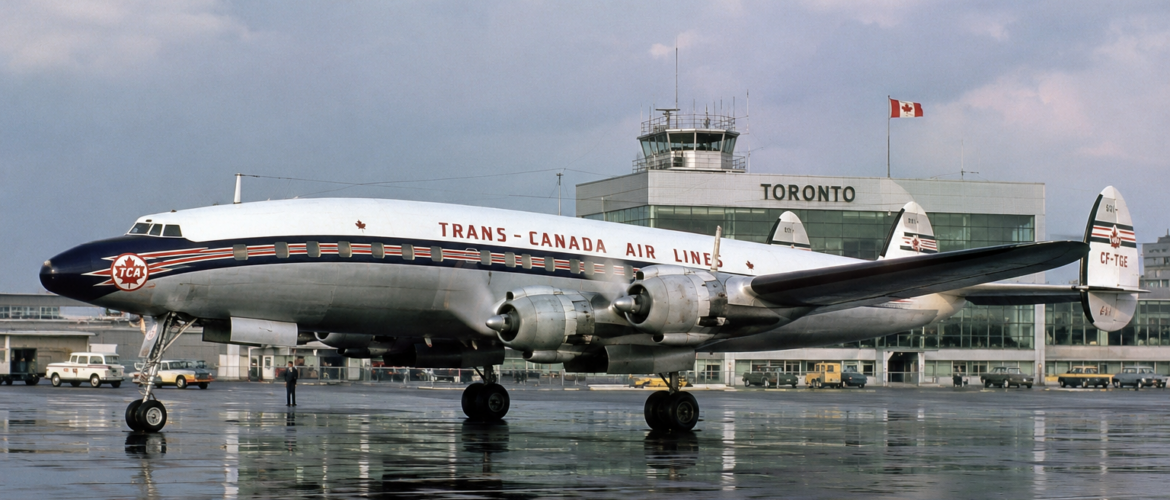
The Lockheed Super Constellation: Connecting Canada to the World
Before the age of Boeing 777s, Airbus A350s, and modern jet travel, one aircraft helped define Canada’s international airline network: the Lockheed L-1049 Super Constellation.
Known affectionately as the “Super Connie,” this remarkable aircraft became one of the most recognizable airliners of the 1950s and played an important role in connecting Canada with destinations across Europe, the Caribbean, and beyond.
With its distinctive triple-tail design, elegant curved fuselage, and four powerful radial engines, many aviation historians consider the Super Constellation to be one of the most beautiful airliners ever built.
Canada’s Gateway to International Travel
In the years following World War II, international air travel was growing rapidly.
Canada’s national airline at the time, Trans-Canada Air Lines, sought a modern aircraft capable of providing faster, longer-range service to international destinations.
The answer was the Super Constellation.
Beginning in the mid-1950s, Trans-Canada Air Lines introduced a fleet of Super Constellations to serve some of its most important routes. These aircraft allowed Canadian passengers to travel across the Atlantic in greater comfort and with improved reliability compared to earlier generations of airliners.
For many Canadians, boarding a Super Constellation represented their first opportunity to travel internationally by air.
Serving Canadian Cities
The Super Constellation became a familiar sight at major Canadian airports.
Passengers departing from cities such as:
- Toronto
- Montreal
- Vancouver
could connect to destinations throughout Europe and the Caribbean.
At a time when international travel was still considered a luxury, the Super Constellation helped bring the world closer to Canada.
Engineering Excellence
The Super Constellation represented the peak of piston-engine airliner technology.
Key features included:
- Pressurized passenger cabin
- Long-range transatlantic capability
- Four Wright R-3350 engines
- Cruising speeds approaching 300 mph (260 knots)
- Advanced navigation equipment for its era
- Distinctive triple-tail configuration
The triple-tail design became the aircraft’s trademark. Lockheed engineers needed a large vertical stabilizer for directional stability, but also wanted the aircraft to fit inside existing airport hangars. Their solution was to divide the tail into three smaller fins instead of one large one.
The result became one of aviation’s most recognizable silhouettes.
A Symbol of Canada’s Aviation Growth
During the 1950s, Canada was rapidly expanding its aviation infrastructure.
New airports, navigation systems, and international routes were being developed across the country.
The Super Constellation arrived at exactly the right time.
The aircraft helped establish Canada as a major participant in global air transportation and demonstrated the country’s growing connections with Europe, the United States, and other international markets.
For business travelers, immigrants, tourists, and families, the Super Constellation helped make international travel more accessible than ever before.
The Arrival of the Jet Age
Like many piston-engine airliners, the Super Constellation eventually faced competition from a new generation of jet aircraft.
The introduction of aircraft such as the Douglas DC-8 and Boeing 707 dramatically reduced travel times and changed passenger expectations.
By the early 1960s, Canada’s airlines began transitioning to jet-powered fleets.
Although the Super Constellation’s commercial career was relatively short, its impact on Canadian aviation was enormous.
Remembering the “Super Connie”
Today, the Super Constellation remains one of the most admired aircraft ever built.
Its elegant design, distinctive sound, and important role in Canada’s aviation history continue to inspire pilots, historians, and aviation enthusiasts.
Many Canadians who flew aboard the aircraft still remember the experience of crossing the Atlantic while listening to the rhythmic sound of four radial engines carrying them toward distant destinations.
The Super Constellation was more than just an airplane.
It was a symbol of a growing nation, a bridge between Canada and the world, and one of the aircraft that helped usher Canadian aviation into the modern era.
For aviation enthusiasts, the Super Connie remains a reminder of a time when flying was not just transportation—it was an adventure.