Blog
PPL Written Exam Format & What to Expect (Canada)
PPL Written Exam Format & What to Expect (Canada)
Getting ready for your Private Pilot Licence (PPL) written exam in Canada involves more than just studying meteorology, navigation, air law, and general knowledge. Understanding the exam mechanics — what you’re allowed to bring, how your score is calculated, what happens if you don’t pass a section, and how long your results remain valid — matters just as much as mastering the academic content.
Many student pilots spend months preparing theory but walk into the testing centre uncertain about the procedural details. This guide closes that gap.
This is not a study guide.
This article focuses exclusively on format, structure, and administrative procedures for the Canadian PPL written exam.
The PPL Written Exam in Context
The PPL written exam is a required component for obtaining a Private Pilot Licence — Aeroplane in Canada. It is administered under the authority of Transport Canada to verify that applicants possess the theoretical knowledge required for safe flight operations.
The governing reference document is:
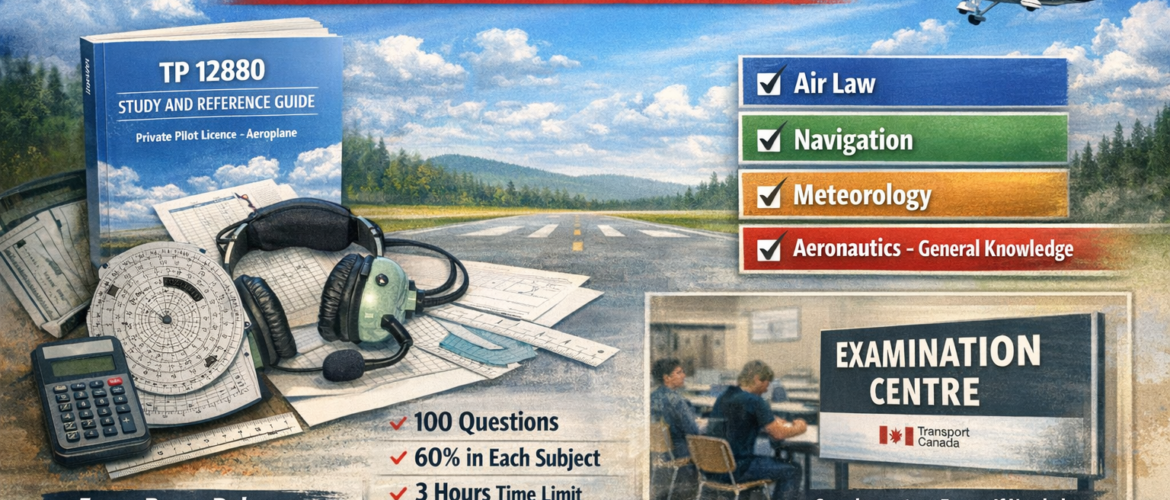
TP 12880 – Study and Reference Guide for Written Examinations, Private Pilot Licence—Aeroplane
The PPL written exam is separate from:
-
PSTAR – Student Pilot Permit written test (completed before first solo)
-
ROC-A – Restricted Operator Certificate (Aeronautical) for radio privileges
-
Flight Test – Practical flight skills assessment
You must pass the written exam before your licence can be issued. However, you may write it before or after your flight test (most students choose to complete it beforehand).
What TP 12880 Really Is — Your Rulebook
TP 12880 outlines:
-
Subject areas tested
-
Time allowances
-
Passing requirements
-
Supplementary examination rules
-
Prerequisites
-
Permitted materials
It does not contain exam questions.
It defines the boundaries of testable knowledge. If a topic appears in TP 12880, it’s fair game. If it’s not listed, there’s no guarantee it will be tested.
Think of TP 12880 as the regulatory framework behind your PPL written exam.

PPL Written Exam Format (PPAER)
The official exam code is:
PPAER — Private Pilot — Aeroplane
Structure
-
100 multiple-choice questions
-
3 hours total time
-
60% overall passing mark
-
60% minimum required in each subject area
This dual requirement is critical.
You must:
-
Achieve 60% overall, and
-
Achieve 60% in each of the four subject areas
A strong overall score cannot compensate for failing one subject.
Example:
70% overall but 55% in Meteorology = partial pass → supplementary exam required.
Mandatory Subject Areas
Each of the following must be passed independently:
-
Air Law – 60% minimum
-
Navigation – 60% minimum
-
Meteorology – 60% minimum
-
Aeronautics — General Knowledge – 60% minimum
Failing even one area means writing a supplementary exam for that subject.
Supplementary Exams (If Required)
If you achieve 60% overall but fail one or more subject areas, you may write supplementary exams instead of rewriting the full PPAER.
| Subject | Code | Questions | Time | Pass Mark |
|---|---|---|---|---|
| Air Law | PALAW | 20 | 1 hour | 60% |
| Navigation | PANAV | 20 | 2 hours | 60% |
| Meteorology | PAMET | 30 | 1.5 hours | 60% |
| Aeronautics | PAGEN | 30 | 1.5 hours | 60% |
If writing multiple supplementary exams on the same day, total time is capped at 3 hours maximum.
This system allows you to focus on weaker areas without retaking all 100 questions.
Prerequisites Before Writing
Before writing the PPAER, you must have:
-
Valid Category 1, 3, or 4 Aviation Medical Certificate
-
Government-issued photo ID
-
Letter of Recommendation from a qualified flight instructor
-
Demonstrated proficiency in English or French
The Letter of Recommendation confirms that your instructor believes you are prepared.
Without it, you cannot write the exam.
What You Can (and Cannot) Bring
Permitted Items
-
Pencil
-
Approved calculator (memory cleared)
-
Ruler
-
Protractor
-
Flight computer (E6B mechanical or approved electronic version)
Prohibited Items
-
Notes or reference materials
-
Mobile phones
-
Unauthorized electronic devices
-
Assistance from another person
Violation results in:
-
Immediate exam failure
-
One-year ban from writing Transport Canada exams
Transport Canada enforces these rules strictly.
Result Validity & Rewrite Rules
How Long Results Stay Valid
Your written exam results remain valid for 24 months from the pass date.
If you do not complete licence issuance within that timeframe, you may need to rewrite.
Waiting Periods After Failure
-
After first failure: 14 days
-
After second failure: 30 days
-
After third or subsequent failures: 30 days + 30 additional days per failure (maximum 180 days)
Waiting periods may be reduced with instructor-certified remedial training.
What You Receive After Writing
You will receive a feedback statement, not your exam paper.
You will not be told:
-
Which questions you got wrong
-
What the correct answers were
Instead, you’ll see generalized feedback such as:
“Identify atmospheric conditions favorable for thunderstorm formation.”
This indicates knowledge gaps without revealing exam content.
Where You Can Write the Exam
The PPAER can be written at:
-
An Authorized Examination Invigilator (AEI) at your flight school
-
A Transport Canada examination centre
Most students write at their Flight Training Unit if an AEI is available.
Booking is arranged:
-
Through your flight school
-
Or via Transport Canada’s online portal
Where the Written Exam Fits in Your Training
A typical student progression:
-
PSTAR
-
ROC-A
-
Dual flight training
-
Ground school completion
-
PPAER written exam
-
Flight test
The written exam usually occurs in the mid-to-late phase of training.
Understanding where it fits helps reduce uncertainty.
Essential Points to Remember
-
Each subject must be passed independently
-
Strong overall performance cannot compensate for weak subject scores
-
Administrative details matter just as much as theory
-
Prerequisites must be satisfied before writing
-
Supplementary exams are focused and efficient
-
Results remain valid for 24 months
-
Balanced study across all four subjects is essential
Final Thoughts
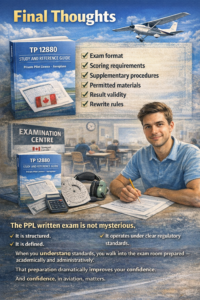
TP 12880 – Study and Reference Guide for Written Examinations, Private Pilot Licence—Aeroplane is Canada’s official framework for the PPL written exam.
Understanding:
-
Exam format
-
Scoring requirements
-
Supplementary procedures
-
Permitted materials
-
Result validity
-
Rewrite rules
is just as important as mastering navigation or meteorology.
The PPL written exam is not mysterious.
It is structured.
It is defined.
It operates under clear regulatory standards.
When you understand those standards, you walk into the exam room prepared — academically and administratively.
That preparation dramatically improves your confidence.
And confidence, in aviation, matters.
Common Questions
How is the Canadian PPL written exam structured?
100 multiple-choice questions, 3 hours, 60% overall and 60% in each subject.
Must I pass each subject area independently?
Yes. All four subjects require a minimum 60%.
What do I need before writing?
Valid medical certificate, photo ID, Letter of Recommendation, and language proficiency.
What am I allowed to bring?
Pencil, cleared calculator, ruler, protractor, and E6B. No notes or phones.
What happens if I don’t pass?
Partial pass = supplementary exams.
Complete failure = mandatory waiting period.
Results remain valid for 24 months.
The PPL written examination presents a defined challenge with transparent standards.
Understanding both the knowledge expectations and the administrative structure ensures you arrive prepared — and that preparation makes success far more achievable.