
Blog
Cessna 152: The Affordable Trainer That Built Canadian Aviation
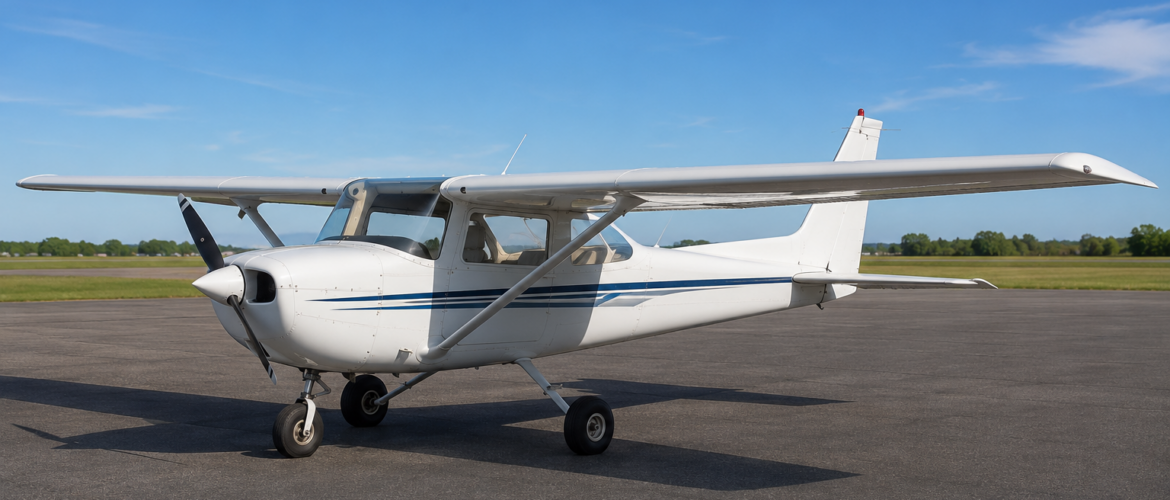
Few aircraft have introduced more Canadians to aviation than the Cessna 152.
Simple, reliable, and economical to operate, the Cessna 152 became one of the most important training aircraft in Canadian aviation history. For thousands of pilots, the journey toward a Private Pilot Licence, Commercial Pilot Licence, or airline career began in the left seat of a 152.
While larger and more advanced aircraft often receive the spotlight, the Cessna 152 quietly became one of the greatest pilot-making machines ever built.
The Perfect Training Aircraft
Introduced in 1977 as the successor to the Cessna 150, the 152 was designed specifically with flight training in mind.
The aircraft offered everything a student pilot needed:
- Predictable handling
- Excellent visibility
- Simple systems
- Forgiving flight characteristics
- Low operating costs
- Reliable performance
For flight schools, this combination was ideal. Students could focus on learning how to fly rather than managing complex aircraft systems.
Even today, instructors often describe the Cessna 152 as one of the best aircraft ever created for teaching fundamental flying skills.
A Common Sight Across Canada
For decades, the Cessna 152 could be found at nearly every flight school in Canada.
From British Columbia to Newfoundland, generations of student pilots learned:
- Takeoffs and landings
- Navigation
- Radio communication
- Emergency procedures
- Cross-country flying
- Stall recovery
- Flight test preparation
The aircraft became a familiar sight in airport circuits across the country.
For many Canadians, hearing the sound of a small Cessna overhead became synonymous with flight training.
The Airplane of First Solos
Every pilot remembers their first solo flight.
For countless Canadian aviators, that milestone occurred in a Cessna 152.
After hours of dual instruction, students would finally hear the words:
“Take it around by yourself.”
With the instructor stepping out, the aircraft suddenly felt lighter, climbed faster, and carried a significance that would never be forgotten.
Many airline captains, military pilots, bush pilots, and flight instructors still remember the exact day they first flew a Cessna 152 alone.
The aircraft helped transform aviation dreams into reality.
Affordable Aviation
One of the greatest strengths of the Cessna 152 was affordability.
Flight schools appreciated:
- Low fuel consumption
- Simple maintenance
- Proven reliability
- Long service life
Students appreciated:
- Lower rental costs
- Accessible training opportunities
- Straightforward operation
By helping keep training costs manageable, the Cessna 152 opened the door to aviation careers for thousands of Canadians.
A Strong Foundation for Professional Pilots
Although the Cessna 152 is a basic aircraft, it teaches skills that remain relevant throughout a pilot’s career.
Students learn:
- Proper aircraft control
- Situational awareness
- Energy management
- Decision-making
- Precision flying
These fundamentals transfer directly to larger aircraft.
Many pilots who now fly Boeing 737s, Airbus A320s, Dash 8s, and business jets first developed their flying skills in a 152.
Why Pilots Still Love It
Modern aircraft may feature glass cockpits, autopilots, and advanced avionics, but many pilots still enjoy flying the Cessna 152.
The aircraft offers something increasingly rare:
Pure flying.
There are few distractions and few systems to manage.
The pilot learns to feel the airplane, understand the wind, and master the basics of flight.
For many aviators, the Cessna 152 represents aviation in its simplest and most enjoyable form.
A Lasting Canadian Legacy
Today, many Cessna 152s remain active in Canadian flight schools despite being decades old.
Their continued presence is a testament to the aircraft’s durability and timeless design.
The Cessna 152 may not be the fastest aircraft in the sky.
It may not be the most technologically advanced.
Yet its contribution to Canadian aviation is enormous.
By training generations of pilots and making flight more accessible, the aircraft helped build the foundation of Canada’s aviation community.
For many Canadians, their aviation story began with a checklist, a headset, and a Cessna 152 waiting on the ramp.