
Blog
CF-18 Hornet: The Fighter That Defended Canada for a Generation
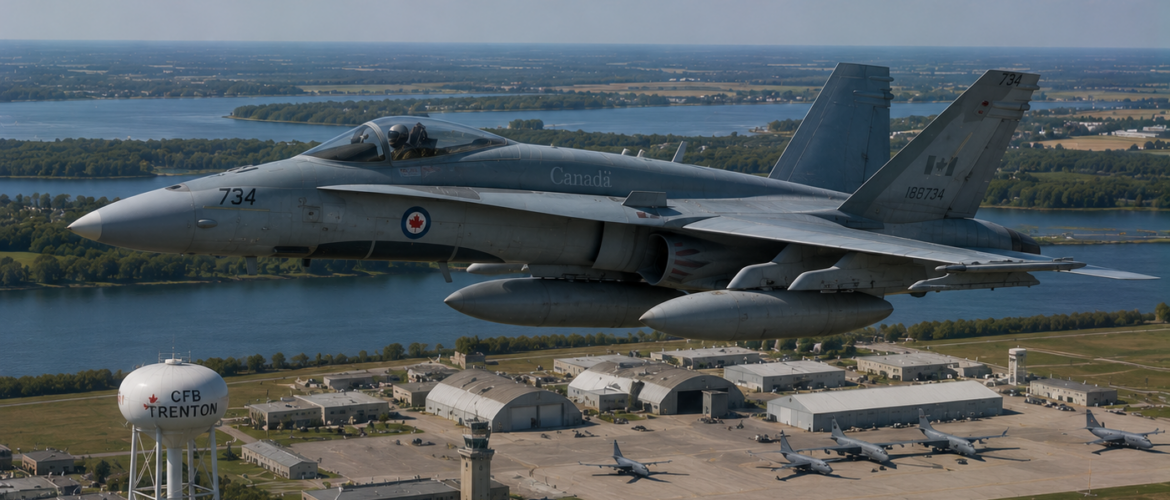
For more than four decades, the CF-18 Hornet has been the face of Canadian military aviation.
From defending North American airspace through NORAD missions to participating in international operations around the world, the CF-18 has served as Canada’s primary fighter aircraft since the early 1980s. Its distinctive appearance, impressive versatility, and long service record have made it one of the most recognizable aircraft in Canadian history.
For many Canadians, when they think of a fighter jet, they think of the CF-18.
A New Fighter for a New Era
In the late 1970s, Canada needed a replacement for several aging aircraft, including:
- CF-101 Voodoo
- CF-104 Starfighter
- CF-116 Freedom Fighter
The government selected the McDonnell Douglas F/A-18 Hornet, which would become known in Canadian service as the CF-18 Hornet.
The aircraft offered:
- Air-to-air combat capability
- Ground attack capability
- Modern radar systems
- Carrier-based durability
- Twin-engine reliability
It was the perfect aircraft for a nation that required both domestic defense and expeditionary capability.
The Aircraft That Guards Canada’s Skies
One of the CF-18’s most important roles has been defending Canadian airspace.
Operating through NORAD, CF-18 pilots routinely conduct:
- Air sovereignty missions
- Intercepts of unidentified aircraft
- Arctic patrols
- Quick Reaction Alert operations
- Joint exercises with allied forces
Because Canada possesses one of the largest airspaces on Earth, the Hornet has spent decades protecting vast northern regions and supporting continental defense.
Built for Canada’s Arctic
Few fighter aircraft spend as much time operating in extreme cold as the CF-18.
The aircraft routinely flies missions in:
- Yukon
- Northwest Territories
- Nunavut
- Northern Quebec
- Arctic Ocean regions
These operations require aircraft capable of performing reliably in harsh weather conditions far from major support facilities.
The Hornet proved itself exceptionally capable in these environments.
For decades, it has served as Canada’s first line of aerial defense in the North.
Tested in Combat
The CF-18 has participated in numerous international operations.
Canadian Hornets have served in:
Gulf War (1991)
The CF-18 became the first Canadian fighter aircraft to conduct combat missions since the Korean War.
Canadian pilots flew escort and attack missions during coalition operations against Iraq.
Kosovo (1999)
Canadian CF-18s participated in NATO air operations over the Balkans, conducting precision strike missions and supporting allied forces.
Libya (2011)
During Operation Mobile, Canadian Hornets played a significant role in enforcing the no-fly zone and conducting precision strikes.
Iraq and Syria
The aircraft later participated in coalition operations against ISIS, demonstrating that even decades after entering service, it remained a highly capable combat platform.
The Famous Canadian Spotlight
One of the most distinctive features of the CF-18 is something many people notice immediately.
Unlike American Hornets, Canadian CF-18s feature a powerful spotlight mounted on the left side of the nose.
This unique modification assists pilots during:
- Interception missions
- Aircraft identification
- Night operations
- NORAD patrols
The spotlight has become one of the easiest ways to identify a Canadian Hornet.
A Pilot’s Aircraft
Pilots consistently praise the CF-18 for its versatility.
The aircraft offers:
- Excellent maneuverability
- Strong low-speed handling
- Powerful twin engines
- Reliable systems
- Multi-role flexibility
Whether conducting air combat training, precision strike missions, or Arctic patrols, the Hornet proved capable of adapting to almost any mission.
Many Canadian fighter pilots spent their entire careers flying the CF-18.
The Snowbirds of the Fighter World
Although the Snowbirds fly the CT-114 Tutor, the CF-18 demonstration team became one of Canada’s most popular aviation attractions.
Every year, specially painted demonstration aircraft travel across Canada performing high-speed displays.
These demonstrations inspire future pilots and showcase Canadian military aviation to millions of spectators.
Preparing for the Future
After more than 40 years of service, the CF-18 is gradually being replaced by the F-35 Lightning II.
While the F-35 will bring new capabilities, the CF-18’s contribution to Canadian defense cannot be overstated.
The aircraft has protected Canadian airspace, served alongside allies, and represented Canada on the world stage for generations.
A Lasting Legacy
Few military aircraft have served Canada as faithfully as the CF-18 Hornet.
For more than four decades, it has defended the nation, supported international security operations, and inspired countless Canadians through airshows and military service.
It became much more than a fighter jet.
It became a symbol of Canadian air power.
As the Hornet gradually retires, it leaves behind one of the most impressive service records in Canadian aviation history.
CF-18 Hornet Fast Facts
Manufacturer: McDonnell Douglas (now Boeing)
Country of Origin: United States / Canadian Variant
Canadian Service Entry: 1982
Top Speed: Mach 1.8 (approximately 1,190 mph / 1,915 km/h)
Range: Approximately 1,200 nautical miles
Engines: 2 × General Electric F404 Turbofans
Role: Multirole Fighter
Fun Fact
The CF-18’s distinctive nose-mounted spotlight is unique among Hornet operators and was added specifically to help Canadian pilots visually identify aircraft during NORAD interception missions.
Legend Status
⭐⭐⭐⭐⭐
The CF-18 Hornet defended Canada for more than 40 years and became one of the most iconic and respected aircraft in Canadian military aviation history.