
Blog
F-22 Raptor: The Fighter That Changed Air Combat Forever
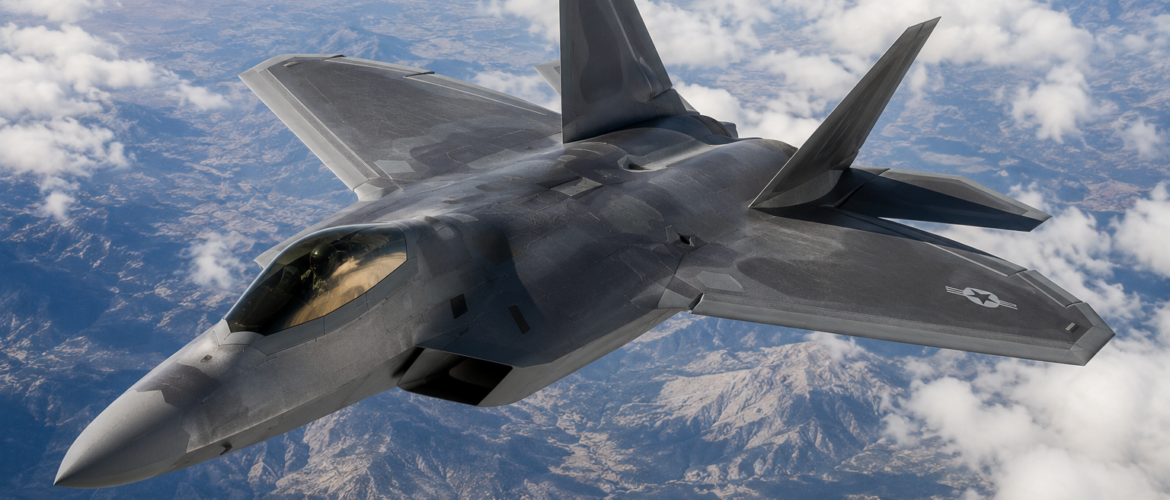
Few aircraft have achieved the legendary status of the Lockheed Martin F-22 Raptor.
Widely regarded as the most capable air superiority fighter ever built, the F-22 combined stealth, speed, maneuverability, and advanced sensor technology in a way that completely changed modern aerial warfare.
For over two decades, the Raptor has represented the pinnacle of fighter aircraft design. Although Canada has never operated the F-22—and cannot purchase it due to U.S. export restrictions—the aircraft regularly participates in NORAD exercises and operations that help defend North American airspace.
Many aviation experts consider the F-22 the benchmark against which all modern fighters are measured.
Built to Dominate the Skies
The F-22 was developed during the final years of the Cold War.
The United States wanted an aircraft capable of defeating any future fighter while maintaining air superiority well into the 21st century.
The result was a revolutionary aircraft featuring:
- Stealth technology
- Supercruise capability
- Thrust-vectoring engines
- Advanced sensor fusion
- Extreme maneuverability
- Low radar signature
The aircraft entered service in 2005 and immediately became one of the most advanced military aircraft ever constructed.
The Meaning of Air Superiority
Unlike multirole fighters such as the F-35, the F-22 was designed primarily for one mission:
Control the skies.
Its purpose is to:
- Destroy enemy fighters
- Eliminate airborne threats
- Protect friendly aircraft
- Maintain dominance over contested airspace
In many military circles, the F-22 is considered the ultimate air-to-air combat aircraft.
Stealth Before the Enemy Sees You
One of the Raptor’s greatest strengths is stealth.
The aircraft was designed to be extremely difficult to detect using radar.
This allows it to:
- Approach threats undetected
- Strike first
- Avoid enemy tracking
- Increase survivability
Many analysts believe that in a real-world engagement, the F-22 would often detect an opposing aircraft long before being detected itself.
In air combat, seeing first usually means winning first.
Supercruise: Flying Faster Without Afterburners
The F-22 introduced a capability known as supercruise.
Most fighter aircraft require fuel-hungry afterburners to sustain supersonic flight.
The Raptor can cruise at speeds exceeding:
Mach 1.5
without using afterburners.
This provides:
- Increased range
- Reduced fuel consumption
- Lower infrared signature
- Faster response times
The ability to fly supersonic for extended periods remains one of the aircraft’s most impressive achievements.
Incredible Maneuverability
The F-22’s twin Pratt & Whitney F119 engines feature thrust-vectoring nozzles.
Unlike conventional engines, these nozzles can move and direct engine thrust.
This allows the aircraft to perform maneuvers that appear almost impossible.
The Raptor can:
- Execute extreme high-angle turns
- Recover quickly from difficult flight attitudes
- Maintain control at low airspeeds
- Outmaneuver most conventional fighters
Airshow demonstrations often leave spectators stunned by what the aircraft can do.
Protecting North America
Although Canada does not operate the F-22, Canadians benefit from its presence through NORAD.
F-22s routinely deploy to:
- Alaska
- Arctic regions
- NORAD exercises
- Continental defense missions
These deployments help protect North American airspace and support Canada’s shared defense responsibilities with the United States.
When unidentified aircraft approach North American airspace, the F-22 is often among the first aircraft available to respond.
A Pilot’s Dream Machine
Pilots consistently describe the F-22 as one of the most capable aircraft ever flown.
They praise:
- Exceptional acceleration
- Outstanding handling
- Sensor integration
- Situational awareness
- High-performance flight characteristics
The aircraft combines raw performance with advanced technology in a way few aircraft have ever achieved.
Why So Few Were Built
Despite its incredible capabilities, the F-22 program was limited.
Only 187 operational aircraft were produced.
Several factors contributed:
- High development costs
- End of the Cold War
- Changing military priorities
- Focus on multirole aircraft
In 2009, production ended.
As a result, the F-22 remains one of the rarest frontline fighter aircraft in the world.
The Aircraft That Still Has No Equal
Even after two decades of service, many experts believe the F-22 remains unmatched in pure air-to-air combat capability.
While newer aircraft continue to emerge globally, the Raptor’s combination of:
- Stealth
- Speed
- Supercruise
- Maneuverability
- Sensor fusion
continues to make it one of the most respected fighters ever built.
A Lasting Legacy
The F-22 Raptor represents one of the greatest technological achievements in aviation history.
It redefined what a fighter aircraft could be and established many of the technologies that modern fighters now use.
Although Canadians may never see the Raptor wearing RCAF markings, its role in protecting North American airspace through NORAD makes it an important part of Canada’s defense story.
Few aircraft have ever inspired as much respect.
And fewer still have done so while remaining so far ahead of their time.
F-22 Raptor Fast Facts
Manufacturer: Lockheed Martin
Country of Origin: United States
First Flight: 1997
Service Entry: 2005
Top Speed: Approximately Mach 2.25
Supercruise Speed: Approximately Mach 1.5+
Engines: 2 × Pratt & Whitney F119 Turbofans
Role: Air Superiority Fighter
Fun Fact
The F-22 Raptor is so tightly controlled that U.S. law prohibits its export to any foreign country, including close allies such as Canada, the United Kingdom, and Australia.
Legend Status
⭐⭐⭐⭐⭐
The F-22 Raptor remains one of the most advanced fighter aircraft ever built and is widely considered the gold standard of modern air superiority.