
Blog
F-35 Lightning II: Canada’s Most Advanced Fighter Aircraft
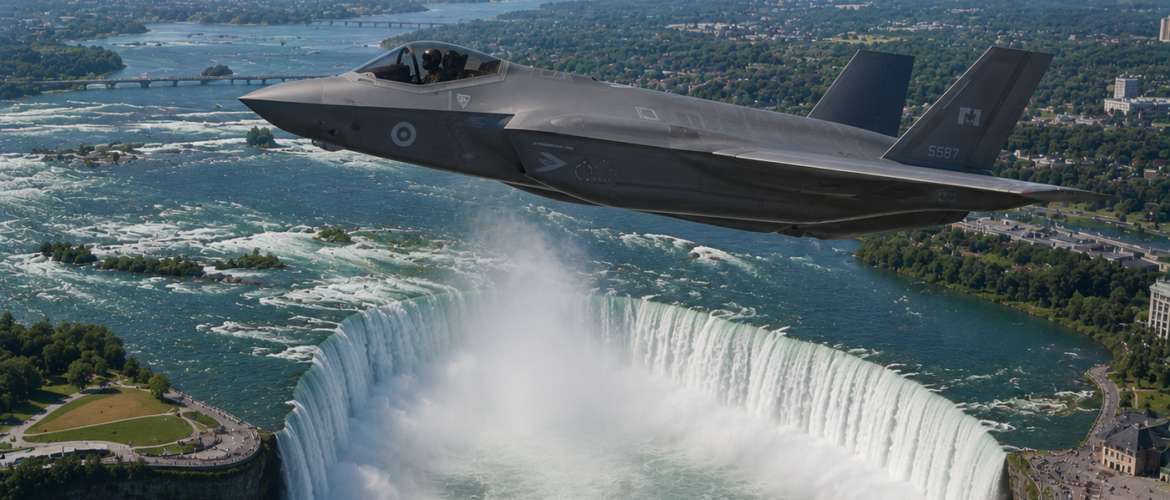
Few military aircraft have generated as much discussion, debate, and excitement as the Lockheed Martin F-35 Lightning II.
Combining stealth technology, advanced sensors, artificial intelligence-assisted systems, and unmatched battlefield awareness, the F-35 represents the most advanced fighter aircraft ever selected by Canada.
For the Royal Canadian Air Force (RCAF), the F-35 is far more than a replacement for the aging CF-18 Hornet fleet. It is a transformational leap into the future of air combat.
A New Era for Canadian Air Power
Canada officially selected the F-35A Lightning II as its next-generation fighter aircraft to ensure the country remains capable of defending North American airspace while fulfilling NATO and international commitments.
Operating in one of the world’s largest airspaces, Canadian fighters must be capable of:
- Arctic sovereignty patrols
- NORAD operations
- NATO deployments
- Air interception missions
- Coalition combat operations
- Intelligence gathering and surveillance
The F-35 was specifically designed to excel in all of these roles.
Stealth Changes Everything
Perhaps the most recognizable feature of the F-35 is its stealth design.
Unlike conventional fighters, the F-35 was engineered to reduce its radar signature dramatically. Special shaping, coatings, and internal weapons bays help make the aircraft difficult for enemy radar systems to detect and track.
This allows pilots to:
- Approach threats undetected
- Gather intelligence safely
- Strike targets before being located
- Operate in heavily defended environments
Stealth is not invisibility, but it dramatically improves survivability.
The Aircraft That Sees Everything
Many pilots describe the F-35 as less of a fighter aircraft and more of a flying sensor platform.
The aircraft continuously gathers information from:
- Radar systems
- Infrared sensors
- Electronic warfare equipment
- Data links
- Satellites
- Other aircraft
This information is fused together into a single tactical picture.
Instead of sorting through multiple displays, the pilot receives a clear, real-time understanding of the battlefield.
This capability is known as sensor fusion, and it is one of the F-35’s greatest advantages.
The Helmet That Replaced the Heads-Up Display
One of the most remarkable features of the F-35 is its advanced helmet system.
Traditional fighter aircraft use a heads-up display mounted in front of the pilot.
The F-35 eliminated this entirely.
Instead, pilots wear a sophisticated helmet that projects flight data directly onto the visor.
The system even allows pilots to “see through” the aircraft using external cameras mounted around the fuselage.
By turning their head, pilots can view imagery from beneath, behind, or beside the aircraft.
This provides unprecedented situational awareness during combat operations.
A Flying Network
Modern warfare increasingly depends on information.
The F-35 acts as a flying command-and-control platform, sharing data with:
- Other F-35s
- NATO aircraft
- Ground forces
- Naval vessels
- NORAD assets
This allows allied forces to coordinate operations more effectively and respond faster to emerging threats.
Rather than fighting alone, the F-35 fights as part of an interconnected network.
Built for the Arctic
Canada’s unique geography places enormous demands on military aircraft.
The F-35’s advanced navigation systems, sensors, and long-range capabilities make it well suited for northern operations.
As Arctic activity increases and global powers expand their presence in the region, maintaining Canadian sovereignty becomes increasingly important.
The F-35 will play a major role in protecting Canadian airspace for decades to come.
Performance
F-35A Lightning II
- Manufacturer: Lockheed Martin
- Role: Multirole Stealth Fighter
- Crew: 1
- Maximum Speed: Mach 1.6 (approximately 1,975 km/h)
- Range: Approximately 2,200 km
- Service Ceiling: 50,000+ feet
- Engine: Pratt & Whitney F135
- Thrust: Approximately 43,000 pounds
- Internal Weapons Capacity: Air-to-air and precision-guided weapons
- Radar: AN/APG-81 AESA Radar
Why It Matters to Canada
The F-35 represents one of the largest technological leaps in Royal Canadian Air Force history.
While earlier fighters focused primarily on speed, maneuverability, and weapons, the F-35’s greatest strength is information dominance.
By combining stealth, advanced sensors, networking, and cutting-edge computing power, it gives pilots a level of battlefield awareness that previous generations could only imagine.
For Canada, the aircraft will help ensure the nation remains capable of defending its skies, supporting allies, and operating effectively in an increasingly complex global security environment.
The F-35 is not simply the next fighter aircraft.
It is the future of Canadian air power.