
Blog
McDonnell Douglas MD-11: The Trijet That Connected Canada to the World
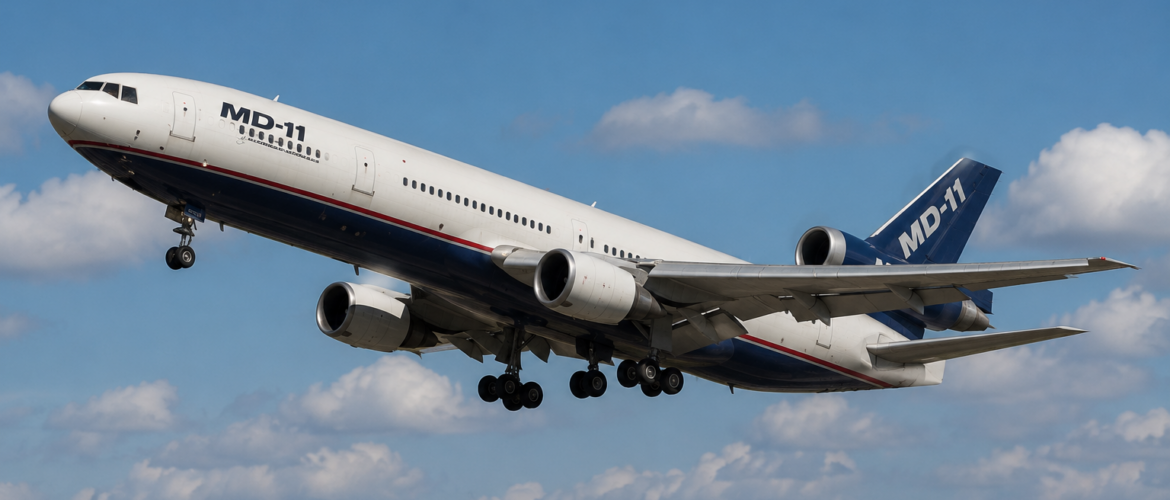
Few aircraft are as distinctive as the McDonnell Douglas MD-11.
With its three-engine design, elegant lines, and long-range capability, the MD-11 represented the final evolution of the classic trijet airliner. Arriving during a transitional period in aviation history, the aircraft bridged the gap between the jumbo jet era of the 1970s and the highly efficient twin-engine aircraft that dominate the skies today.
For Canada, the MD-11 played an important role in international travel, cargo transportation, and global trade. Although its passenger service career was relatively short compared to some competitors, the aircraft continues flying today as one of the world’s most capable freighters.
The MD-11 may no longer carry large numbers of passengers, but its legacy remains firmly established.
The Final Trijet
The MD-11 was developed from the highly successful DC-10.
Engineers sought to create a more advanced aircraft that offered:
- Greater range
- Improved fuel efficiency
- Modern avionics
- Increased payload capacity
- Enhanced cockpit automation
The result was the MD-11, which first flew in 1990.
At the time, it represented one of the most technologically advanced wide-body aircraft in the world.
The Distinctive Third Engine
What immediately sets the MD-11 apart is its appearance.
Unlike most modern airliners, the aircraft features three engines:
- One under each wing
- One mounted in the tail
This trijet configuration became a hallmark of aircraft such as:
- Boeing 727
- Lockheed L-1011 TriStar
- Douglas DC-10
- McDonnell Douglas MD-11
The design offered long-range capability before modern ETOPS regulations allowed twin-engine aircraft to routinely cross oceans.
For many aviation enthusiasts, the MD-11 remains one of the most beautiful airliners ever built.
Canadian Airlines and the MD-11
The MD-11 became an important part of Canadian aviation through Canadian Airlines International.
During the 1990s, Canadian Airlines operated MD-11 aircraft on international routes connecting Canada to destinations across:
- Europe
- Asia
- South America
- The United States
The aircraft’s long range made it particularly useful for Canada’s vast geography and international route structure.
For many Canadian travelers, their first long-haul international flight was aboard an MD-11.
A Global Airliner
The MD-11 served with numerous airlines worldwide, including:
- KLM
- Swissair
- Finnair
- Delta Air Lines
- American Airlines
- Japan Airlines
- Varig
The aircraft was designed to compete with:
- Boeing 747
- Airbus A340
- Boeing 767
Although it never achieved the sales numbers of some competitors, it became a respected long-haul aircraft throughout the aviation industry.
The Cargo King
While passenger airlines gradually retired the MD-11, the aircraft found a second life as a freighter.
Today, many of the world’s remaining MD-11s operate cargo missions.
Major operators include:
- FedEx Express
- UPS Airlines
- Various international cargo carriers
Its large cargo capacity and long range make it exceptionally valuable for freight operations.
In fact, the MD-11 has become one of the most successful cargo aircraft of the modern era.
Frequent Visitor to Canada
Even after passenger operations declined, the MD-11 remained a familiar sight at Canadian airports.
Cargo operators continue to use the aircraft at:
- Toronto Pearson
- Vancouver International
- Calgary International
- Hamilton International
- Montreal-Mirabel
These aircraft transport:
- E-commerce shipments
- Medical supplies
- Industrial equipment
- International freight
Every day, MD-11 freighters help support Canada’s economy and global supply chains.
A Pilot’s Perspective
Pilots often describe the MD-11 as a highly capable but demanding aircraft.
They praise:
- Long-range performance
- Advanced flight systems
- Cargo capability
- Efficient cruise characteristics
At the same time, the aircraft earned a reputation for requiring precision during landing due to its unique handling characteristics.
Mastering the MD-11 became a point of pride for many professional pilots.
The End of the Passenger Era
By the early 2000s, airlines increasingly favored new twin-engine aircraft such as:
- Boeing 777
- Airbus A330
- Boeing 787 Dreamliner
These aircraft offered lower operating costs and improved efficiency.
As a result, passenger MD-11 fleets gradually disappeared.
However, unlike many retired airliners, the MD-11 avoided retirement thanks to its exceptional cargo capabilities.
One of the Last Great Trijets
The MD-11 represents the final chapter of the trijet era.
Aircraft designers eventually moved toward highly efficient twin-engine aircraft, making three-engine airliners increasingly rare.
Today, the MD-11 stands as one of the last major commercial trijets still flying.
For aviation enthusiasts, it represents a unique and important period in aerospace history.
A Lasting Legacy
The McDonnell Douglas MD-11 may not have achieved the commercial success originally envisioned, but it carved out an important place in aviation history.
For Canada, it connected cities across oceans, supported international commerce, and continues to move freight around the globe.
Its distinctive profile, powerful performance, and enduring cargo career have ensured that the MD-11 remains one of the most respected aircraft ever built.
MD-11 Fast Facts
Manufacturer: McDonnell Douglas
Country of Origin: United States
First Flight: 1990
Entry Into Service: 1991
Passengers: Approximately 285–410 depending on configuration
Range: Approximately 7,000 nautical miles
Engines: 3 × Turbofan Engines
Role: Long-Haul Passenger Airliner / Cargo Freighter
Fun Fact
The MD-11 is one of the last major trijet airliners ever produced. Today, most surviving examples fly cargo routes, making it a favorite aircraft among aviation enthusiasts and freight operators alike.
Legend Status
⭐⭐⭐⭐⭐
The MD-11 was the final evolution of the classic trijet airliner—a unique aircraft that connected Canada to the world and continues to serve global trade decades after its introduction.