
Blog
Supermarine Spitfire: The Aircraft That Saved Britain and Inspired the World
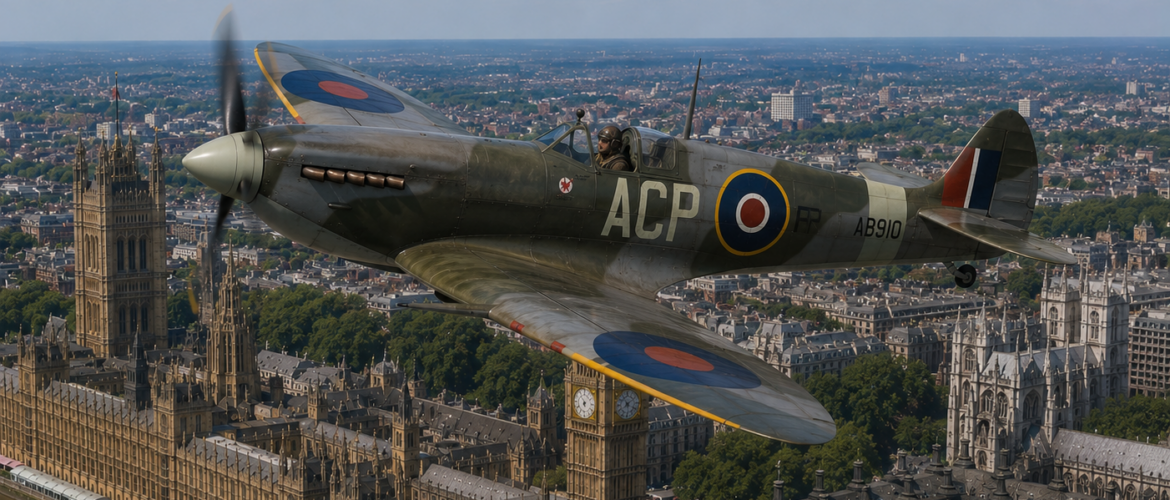
Few aircraft in history are as legendary as the Supermarine Spitfire.
With its elegant elliptical wings, powerful Rolls-Royce Merlin engine, and incredible performance, the Spitfire became the symbol of Allied resistance during the Second World War. More than just a fighter aircraft, it became a national icon and one of the most recognizable airplanes ever built.
For Canadians, the Spitfire holds special significance. Thousands of Canadian pilots flew the aircraft during the war, helping defend Britain, escort bombers over Europe, and secure Allied victory.
More than 80 years later, the Spitfire remains one of the most beloved aircraft in aviation history.
Born for Speed
Designed by R. J. Mitchell, the Spitfire first flew in 1936.
At a time when aviation technology was advancing rapidly, the aircraft introduced several revolutionary features:
- Streamlined elliptical wings
- All-metal construction
- Retractable landing gear
- Powerful Rolls-Royce Merlin engine
- Exceptional maneuverability
The result was one of the fastest and most capable fighters of its era.
The Battle of Britain
The Spitfire became famous during the Battle of Britain in 1940.
As Nazi Germany attempted to gain air superiority over Britain, Spitfire pilots fought against waves of German aircraft.
Although the Hawker Hurricane actually shot down more enemy aircraft during the battle, the Spitfire became the public symbol of Britain’s aerial defense due to its ability to engage the Luftwaffe’s best fighters directly.
Its performance helped prevent a German invasion of Britain and changed the course of the war.
Canadians and the Spitfire
Thousands of Canadians volunteered to serve in the Royal Air Force and the Royal Canadian Air Force during the war.
Many flew Spitfires in combat missions throughout Europe.
Canadian Spitfire pilots participated in:
- The Battle of Britain
- Fighter sweeps over occupied Europe
- Bomber escort missions
- Reconnaissance operations
- D-Day support missions
Several Canadian aces earned distinction flying the Spitfire and helped build Canada’s proud military aviation heritage.
A Pilot’s Airplane
Pilots loved the Spitfire.
The aircraft was known for:
- Responsive controls
- Excellent visibility
- High speed
- Outstanding climb performance
- Superb maneuverability
Many historians consider it one of the finest piston-engine fighters ever built.
Even modern pilots who have had the opportunity to fly restored Spitfires often describe it as one of the most rewarding aircraft ever designed.
Constantly Improving
Unlike many wartime aircraft, the Spitfire evolved continuously throughout the war.
More than 20 major variants were produced.
These improvements included:
- More powerful Merlin engines
- The legendary Rolls-Royce Griffon engine
- Improved armament
- Increased fuel capacity
- Better high-altitude performance
By the end of the war, the Spitfire was significantly more capable than the aircraft that first flew in 1936.
A Global Fighter
The Spitfire served far beyond Britain.
It operated in:
- Europe
- North Africa
- The Mediterranean
- India
- Burma
- Australia
- Canada
The aircraft became one of the most widely respected fighters of the war.
Its combination of beauty and performance made it admired by both allies and adversaries alike.
The Spitfire in Canada Today
Several Spitfires continue to fly in Canada and regularly appear at:
- Airshows
- Aviation museums
- Commemorative events
- Heritage flights
Whenever a Spitfire takes to the air, crowds gather to hear the unmistakable sound of its Rolls-Royce Merlin engine.
For many aviation enthusiasts, few experiences are more memorable.
More Than an Aircraft
The Spitfire became something larger than a machine.
It represented:
- Courage
- Innovation
- Determination
- Freedom
Its story became part of the broader story of the Allied victory during the Second World War.
Even today, the Spitfire remains a symbol of resilience in the face of overwhelming odds.
A Lasting Legacy
The Supermarine Spitfire was not the most heavily armed fighter of the war.
It was not the fastest by the war’s end.
Yet it remains perhaps the most beloved fighter aircraft ever built.
Its role in defending Britain, its connection to Canadian pilots, and its timeless design have secured its place among aviation’s greatest legends.
Few aircraft inspire admiration quite like the Spitfire.
Supermarine Spitfire Fast Facts
Manufacturer: Supermarine Aviation Works
Country of Origin: United Kingdom
First Flight: 1936
Entry Into Service: 1938
Top Speed: Up to 446 mph depending on variant
Engine: Rolls-Royce Merlin or Griffon
Role: Fighter Aircraft
Fun Fact
More than 20,000 Spitfires were built during the Second World War, making it one of the most successful fighter aircraft programs in aviation history.
Legend Status
⭐⭐⭐⭐⭐
The Spitfire became the symbol of Allied air power during the Second World War and remains one of the most iconic aircraft ever to grace the skies.