
Blog
The Piper J-3 Cub: The Airplane That Introduced Canada to Flying
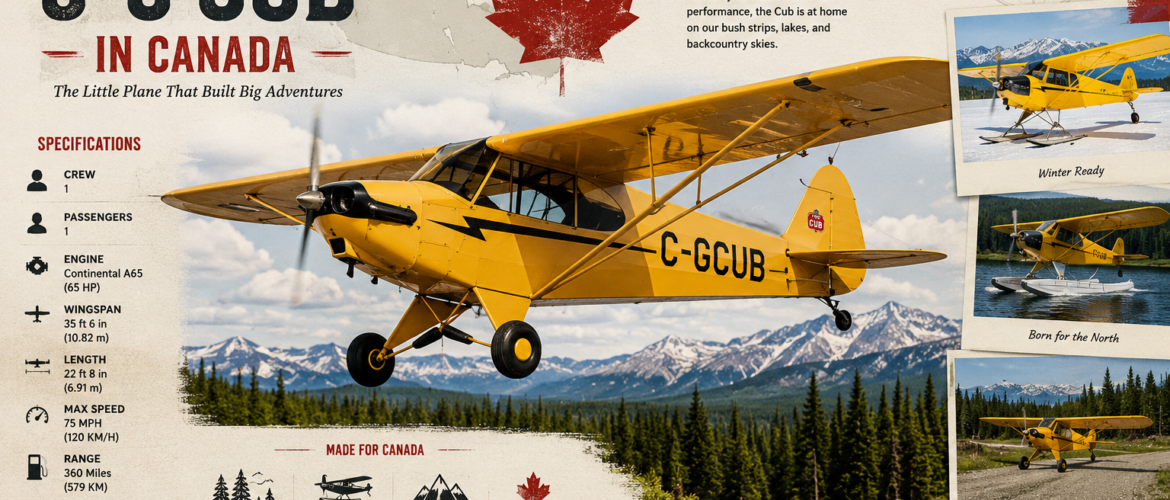
Few aircraft have had a greater impact on aviation than the Piper J-3 Cub.
Simple, affordable, and instantly recognizable with its bright yellow paint scheme, the Cub became one of the most influential aircraft ever built. Long before modern flight schools, advanced avionics, and GPS navigation systems, the J-3 Cub was teaching Canadians how to fly and helping aviation spread across the country.
For many pilots, the Cub wasn’t just an airplane.
It was their first taste of freedom.
A Legend Is Born
The Piper J-3 Cub first appeared in the late 1930s during a period when aviation was rapidly growing across North America.
Designed as an affordable training and recreational aircraft, the Cub featured:
- Two seats arranged in tandem
- Lightweight construction
- Simple controls
- Excellent visibility
- Low operating costs
The aircraft quickly became popular because it made flying accessible to ordinary people.
Before long, the Cub was becoming a familiar sight at airports and grass strips throughout Canada.
Training Pilots During Wartime
One of the Cub’s most important contributions came during the Second World War.
Thousands of military pilots needed basic flight training before progressing to more advanced aircraft.
Aircraft similar to the Cub became ideal primary trainers because they taught essential flying skills without overwhelming students.
Many Canadian pilots who would later fly fighters, bombers, transport aircraft, and bush planes received their earliest flight experience in simple aircraft like the J-3 Cub.
Perfect for Canadian Flying
Canada’s vast geography made light aircraft incredibly valuable.
The Cub could operate from:
- Grass strips
- Farm fields
- Small municipal airports
- Remote communities
- Lakeside airfields
Its low stall speed and forgiving handling characteristics made it ideal for recreational flying and pilot training.
Whether in Ontario, the Prairies, British Columbia, or Atlantic Canada, the Cub became a symbol of grassroots aviation.
The Aircraft That Built Flying Clubs
During the 1940s and 1950s, flying clubs played a major role in Canadian aviation.
Many clubs purchased Cubs because they were inexpensive to operate and easy to maintain.
These aircraft allowed thousands of Canadians to pursue aviation careers or simply experience the joy of flight.
For countless young pilots, the local flying club Cub represented their first step toward becoming:
- Airline pilots
- Bush pilots
- Military aviators
- Flight instructors
- Aircraft owners
The Cub helped democratize aviation in Canada.
A Bush Flying Foundation
Although the Cub was never designed specifically as a bush aircraft, many Canadian operators used it to explore remote regions.
Its ability to fly slowly and land in short distances made it useful for:
- Wildlife observation
- Farm inspections
- Survey work
- Recreational exploration
- Pilot proficiency flying
The aircraft helped establish many of the skills later used by Canada’s legendary bush pilots.
Why Pilots Still Love the Cub
Even today, the J-3 Cub remains one of the most beloved aircraft in the world.
Pilots appreciate its:
- Simplicity
- Lightweight controls
- Excellent visibility
- Low operating costs
- Pure flying experience
There are no complex avionics.
No autopilot.
No distractions.
Just a pilot, a simple aircraft, and the sky.
Many experienced airline captains still describe flying a Cub as one of aviation’s greatest pleasures.
A Living Piece of Aviation History
More than eighty years after its introduction, many J-3 Cubs continue flying throughout Canada.
They can be found at:
- Vintage aircraft fly-ins
- Aviation museums
- Recreational airports
- Flight training organizations
- Private collections
Each flight serves as a reminder of aviation’s golden age.
The Cub’s Canadian Legacy
The Piper J-3 Cub may not have been the fastest aircraft.
It wasn’t the biggest.
It certainly wasn’t the most technologically advanced.
Yet its influence on Canadian aviation is difficult to overstate.
By teaching generations of Canadians how to fly, supporting flying clubs, and making aviation affordable, the Cub helped build the foundation of Canada’s aviation community.
Many of the pilots who would go on to fly airliners, bush planes, military aircraft, and corporate jets began their journey in a simple yellow Cub.
That legacy continues today.